Strategic alliances are great way to rapidly expand your business and generally require less commitment than mergers and acquisitions where changes in ownership are required. The key motivation for alliances is to reduce the risk to both companies through the sharing of resources, access to prospective clients, knowledge sharing, and creating gains in scale and/or productivity.
There are four types of alliances: scale, access, complementary, and collusive.
Scale alliances require partners to work together to achieve advantages they could not easily achieve on their own. It may be better bargaining opportunities to reduce the cost of raw materials, or it could mean using one organization to “white-label” the manufacture of the original company’s products for resale in order to achieve more throughput.
Access alliances typically require one organization that needs the capabilities of the other organization in order to expand their market. For example in many countries, market entry can only be done through a local firm. This local company is exclusively allowed to sell your company’s products and services or you may have a number of companies within the country reselling your products. Local companies in other countries or regions may also want to license your patents, branding, or other intellectual property, expanding your market. Other ways access alliances work are through the ability to share client lists and sell complementary products or services to each other’s client lists.
Complementary alliances are used when one organizations identifies a gap or weakness within their structure or product offering that requires aligning with an organization that has those capabilities and has other weaknesses where the original company is strong. One example of this would be financial services, where one organization is registered for brokerage but not investment banking. A growing investment banking firm would be ideal to partner with in order to better serve each other’s clients with additional services.
Collusive alliances involve any number of companies to combine into cartels, reducing competition in the marketplace, increasing bargaining power with suppliers and price fixing. These types of alliances are more negatively-perceived, especially by regulators. DeBeers Diamonds and OPEC are typical examples of these types of alliances.
There are many potential advantages:
Faster speed of access to new product launches or market areas
Instant increased market share / increased market power
Economies of scale (perhaps by combining production capacity)
Securing new or better sales or distribution channels
Increased control of supply chain and vendor price negotiations
Decreased competition (by taking them over or partnering with them)
To take advantage of deregulation in an industry / market
…but they don’t come without risk. Alliances can turn out to be one-sided. Market changes may make alliances less desirable or make your alliance irrelevant. Your partner may go bankrupt, launch competing products, or become a pariah due to scandal or bad press. Growing a company can be done in many different ways. The most used ways are through internal growth or external growth through acquisitions and alliances. But starting out with a Product/Market Expansion Grid is always a great way to begin planning how you will take your company to the next level.
Last week, we discussed internal growth strategies; today we’ll examine external options.
Inorganic growth is all about increasing productivity or market share through the use of knowledge and experience not internally developed within your company. Instead, this knowledgeable typically comes through consultants, mergers and acquisition, strategic alliances, joint ventures and partnerships.
Consultants
Consulting firms can provide a number of services to assist an organization, either through advice on cutting costs to increase your net profit and shareholder value, or they can identify growth areas in the market and assess the risks of each option through independent research. They can also advise on change management and provide training for your executives and middle management on how to communicate change within your organization. Because they can look at your company without the legacy, sunk costs, and emotion leaders and employees may deal with, consultants can make recommendations that may be hard for those in the business to execute due to how those ideas will affect the human capital of the organization.
Mergers and Acquisitions
Mergers and Acquisition (M&A) offers a distinct set of advantages to increase your competitive advantage. They include:
Business Expansion: M&A is a fast way to enter new markets with established companies that already have the client base and trust in their region or country. Not having to incorporate, not managing the legal issues of market entry can be very appealing. Localization is already embedded within the firm itself.
Consolidation: M&A can bring together two or more competitors that will immediately increase market share, increase efficiency by reducing surplus capacity, increase production throughput, and increase bargaining power with vendors and suppliers.
Adding New Capabilities: Watch the tech incubators and keep updating your knowledge of what’s new in your industry. You don’t want to be caught sleeping when Airbnb or Uber shows up to disrupt your industry. Instead of creating new technology from scratch, invest in a small startup with promising technology that you can exclusively incorporate within your own firm. You can also use this tactic to eliminate threats to your business. A telecom company had created Computer Telephony Integration (CTI) software that enabled small and medium sized businesses to create a single inbox where voicemail, email and faxes could be stored. It enabled anyone to read their emails, listen to .WAV recordings of their voice mails and see the faxes from anywhere they had access to their email. You could also call in and listen to your voicemails, have text-to-speech speak your emails, and use Optical Character Recognition (OCR) technology to read your faxes to you. It was an amazing product that was also very affordable. As the company was gearing up for a major marketing push, Nokia moved in and bought the company for $56 million, put the technology in a box and put it in a closet, never to be seen again. Nokia had been developing a similar product and this product was clearly a threat to them. When they purchased the company, they also got the employees who were clearly capable of integrating their technical knowledge and experience into products being built within Nokia.
Financial Assistance: You may want to put your company on the market if you’re struggling. You may not be able to achieve the profit margins you need in order to sustain your business, but your products or services are solid, your reputation in the market is good and you have a devoted customer base. A larger firm may be able to overlook your financial distress, enabling you to save on interest payments by using the stronger company’s assets to pay off your debt and improve your cash flow. Private equity and investment firms may also be interested in investing in you if you have a solid plan for how you will use those funds to deal with your debt and grow your organization.
Taxes: Depending on where you are located, your tax load may be higher than your competition cutting into your net profits. Acquiring a company in a different state or country may enable you to benefit by transferring your profits or tax losses due to more favorable tax structures, subject to any legal restrictions.
Asset Stripping: Some companies have assets that are worth more than the company as a whole or employees within the firm that have the technical expertise and capabilities that you need to fulfill your growth strategies. You can purchase the firm and sell off or unbundle business units that can significantly reduce your total cost to purchase the company.
Strategic Alliances, Joint Ventures and Partnerships
While M&As bring together organizations through complete changes in ownership, individual companies can join forces to pursue a common growth strategy without sharing ownership in each other’s companies. There are two main types of alliances:
Equity Alliances: The most common form of an equity alliance is a joint venture, where two companies remain independent and incorporate a new firm that is jointly owned by the two companies. When an alliance is formed with multiple partners, they are typically called consortium alliances.
Non-Equity Alliances: Non-equity alliances are typically based on contracts. The most common form of non-equity alliances is franchising where one company gives another company the right to sell the first company’s products or services in a particular location in return for a fee or royalty. Licensing is another type of non-equity alliance which allows another company to use your intellectual property, such as your brand or patents, in return for a fee. Long term subtracting agreements also fall under this category, particularly prevalent in the manufacturing sector’s supply chain.
Alliances, joint ventures and partnerships are a far less risky, less complex and inexpensive option compared to mergers and acquisitions. With either, however, you may still want to involve a management consulting firm to assist you in making these decisions and hopefully keep you from making a very expensive mistake.
There are many ways to build your business, but cleaning house is always the best way to start. Internal growth or organic growth focuses on developing your current workforce, investing in better equipment and expanding the company’s internal resources and capabilities.
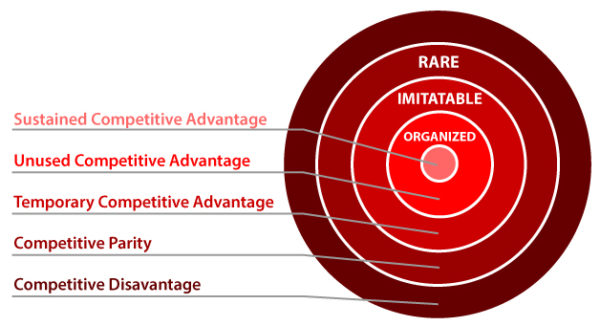
One great methodology would be to start with a VRIO Framework to understand what your core competencies are and what assets the company has that can create a sustained competitive advantage in the future.
VRIO stands for Valuable || Rare || Inimitable || Organized. Let’s examine these values.
Value
How do your customers think you add value? Can you exploit that value by turning it into an opportunity or neutralize your competition? If not, you are at a competitive disadvantage and need to review your core competencies and current offering to uncover what you can offer that would add value. For example, what if you made rubber bands? How could you differentiate your from your competition? Why should someone buy your rubber bands over another? Let’s say that your rubber bands are made of a special rubber that is twice as strong and comes in several colors and widths. You could explore what people use them for and create value for new consumers such as the DIY carpenter using your large bands for clamps. Maybe the colors would attract crafters. Keep looking until you see a way to present your offering that adds value to customers.
Rarity
Do you have total control over a scarce resource? Do you have very specific capabilities that clients would pay a premium to gain competitive advantage over their competition? For example, in the commodities markets, millions of dollars can be lost in a fraction of a second. Having the software that is just a fraction of a second faster or that can process more orders simultaneously could be extremely valuable. If you have realized your value, but in a crowded market with several competitors selling virtually the same software, your company is in a position called competitive parity. Your software may be valuable, but not more valuable to the customer because there are others who also offer similar products or services.
Imitability
Would it be easy for your competition to replicate your success? Would your customers have difficulty finding similar products or services in the marketplace? Would they experience pain in transitioning from your service to another? One good example is Software as a Service (SaaS) software. It is by nature, low cost and built into small affordable components to enable small and medium sized businesses to manage their finances, employees, legal matters, etc., expanding services by adding new components as they grow. HR software is a good example of difficulty of conversion. Say you initially purchase the payroll component to manage your employee’s salaries. This takes a lot of work to set up, entering each employee into the system and ensuring all the data is correct. As you add in the leaves management component, the talent acquisition component, and performance reviews component, it becomes increasingly more difficult for the customer to move to another vendor because the work to convert would outweigh any initial advantages the competition can promise. If your product or service easy to replicate and the cost to convert is simple, you only have a temporary competitive advantage.
Organization
Most startups are filled with chaos. There’s typically no on-boarding. There’s no paper trail for getting leaves approved, you don’t know how to get a stapler… let alone where your documents are printing because they’re never there at the printer in your department. There’s a pain point in all growing companies where all the organization and structure needs to be formally introduced and the change managed all the way to the top of the organization. Strategic communications needs to be formalized. Without this, your company will suffer from unused competitive advantage. There are specialists out there that focus on this move from startup to the next level. It’s not number of employees, or the amount of revenue you’re making. What you’ll see is employee churn. The grapevine becomes the only way people learn what’s going on within the company and that’s never good. You may start losing customers because your customer service isn’t responsive. Find people with experience that can advise you on creating this structure rebuilding your business without losing your unique corporate culture (or maybe that’s part of the problem). If you manage to set standard operating procedures (SOPs) into place for each department, formal job descriptions, paper-based or electronic employee management, you will have achieved sustained competitive advantage.
Okay, now that you’ve cleaned house and have a better understanding of your internal assets and capabilities, it’s now time to look at plans for organic growth. Let’s say your company is managing a profit margin that’s fairly healthy and you have liquidity to look at new opportunities for expansion. It can be as simple investment in faster, modern equipment or robotics to increase throughput in your current factory. It could be expanding the size of your factory to do the same. It may be starting completely new, symbiotic businesses or entering a greenfield market where this product or service has never been sold before. Organic growth is great for your business because:
1. Deeper Knowledgebase: when investigating new opportunities, your senior employees learn more about the options available and learn more through direct involvement in researching that new market or technology. This knowledge is likely to be internalized within the organization and used to make better, more informed decisions when planning growth strategies for your company.
2. Spreading Investment Over Time: gradual growth minimizes the risk since the upfront costs and commitments to major projects can be intense, making it difficult to adjust your plans later if market conditions change. Gradual growth also enables you to provide just-in-time training for your employees, set up standard operating procedures, and manage change through frequent communications with affected departments.
3. No Issues with Availability: You are not dependent on any outside resources, such as consultants or partners, nor do you need to create strategic alliances or acquire companies, so you can identify opportunities, research their feasibility, create prototypes or MVPs and approach customers based on your own internal timeline. Another aspect to this is not having to wait for a perfectly matched acquisition target to appear on the market for you to get started.
4. Strategic Independence: When setting up strategic alliances or partnership agreements, it usually requires negotiation and compromise because both sides have their own agendas and expectations. Alliances and partnerships may require exclusivity clauses, limiting other future opportunities. There can be performance or quality issues that can reflect badly on your company through no fault of your own. Being independent enables you to chart and manage the growth of your company your way, based on your esoteric knowledge of your industry and your customers.
5. Change Management: organic growth facilitates now processes and activities to be communicated through timely emails, company-wide meetings, departmental training and other communications that are appropriate within your existing corporate culture. Maintaining an “open door” policy will enable employees to share their concerns and ideas for improvement. Take the policy seriously and formalize how you respond to new ideas from employees. Respond in a timely manner. Give credit where it is due. The best ideas will come from the lower levels of the company, so don’t discount the janitor’s idea just because he’s the janitor. He’s more in touch with the daily activities of the company than any manager.
Internal growth does have a few disadvantages. Developing internal capabilities can be slow and time-consuming, expensive, and risky if not managed well. Your managers and top level employees really need to understand and support the plans for growth so selling the idea to them before any money is invested is critical. Without middle management support, there can be passive aggressive delays, critical employees quitting, even sabotage, that can derail even the best of strategies. For example, maybe you’ve decided to invest in robotics to automate some of the more time consuming and repetitive components on your production line. Some employees and managers may fear that they will lose their jobs because of this plan. Being proactive about retraining opportunities, options for reassignment within the company and other options will enable managers to discuss the plan more positively and allay any concerns employees may have about your plan.
So think big. Open your mind by asking yourself, “if I had all the money I needed, all the right staff in place, and all the time I needed, what could I do to create growth in my business?” Ask this of your employees as well.
Thinking big has never been a bad idea. In fact, it is the only thing that has ever disrupted industries.
Do you want to outsource this type of work so that you can focus on higher level activities? Subscribe today to learn more about building your business and receive a free PDF “Process Plan for Creating Your Own Innovation Program”. Feel free to email us to learn more about how we can help you grow your business.
CEOs in all industry sectors are now beginning to believe that software and other technical automation processes are a methodology for quickly surpassing your competition. It is not without risks however. I once worked with a CEO who, seriously, refused to buy a server or a database to run a company of 500 people. Instead, everyone’s computers were connected to one other computer of the same size, with only free firewall software that came with the computer. Everything from HR, payroll, accounts receivable and payable, to employee performance and office maintenance was controlled on Excel spreadsheets. And these spreadsheets, in some cases, were over ten years old and were simply moved from one person to the next who took over the job. People did not do backups. It was a pretty scary setup, but it worked. Until it didn’t. People lost or had corrupted files. People would then have to go back through the paper records to recreate the spreadsheets which caused a lot of inaccuracies, errors and just plain missing megabytes of old data because the paper records had gone missing. This was not a way to work and not a way to stay competitive in an increasingly high set of competitors that were SaaS-enabled, or built proprietary software to provide 24/7 service to clients.
These are the Seven Deadly Sins of what not to do when you finally decide that you need to digitally transform your organization:
1. Not Understanding What Digital Transformation Entails
There are four parts to digital transformation. They are the internet, analytics, embedded objects such as RFID tags or barcodes, and mobility. The internet is a vital part of your information delivery system, as simple as a web site and social media pages, but it also can be a very important part of your supply chain in ERP systems. Without analytics, you cannot establish a benchmark of where you started and monitor how much change you have accomplished. RFID tags, bar codes and other embedded systems can significantly automate manufacturing, warehousing, logistics and delivery. Without mobility, you don’t have access to monitoring tools that can facilitate critical decision making 24/7 from anywhere in the world, especially during a crisis.
2. Not Understanding How Technology Transforms Businesses
Everyone has heard at least one story of a tech project that went way over budget and was delivered very late and did not work as expected. That’s typically due to changes in scope, market conditions, changes in leadership, poor project management… the list goes on and on. There are three different ways technology transforms a business:
Substitution: the technology just substitutes for, or replaces, and existing process.
Extension: the technology’s main impact extends the company’s brand or product line into a new platform, such as the internet or mobile.
Transformation: the company begins doing business differently.
Transformation eliminates the issues that can be automated, monitored, measured, produced, etc., in order for leaders and managers to work “on” the business rather than “in” it. They are more able to spend time innovating and creating more value for customers. Both substitution and extension are worthwhile efforts, they will not have the same impact as a complete transformation.
Let’s look at desktop publishing. When I was in college learning about graphic design, we used tables, and wax and photostat cameras. We cut and pasted all the components on a board. We spec’d type which would have to go to someone at a different company to be printed for “camera ready artwork”. We rubbed down Letraset display typefaces and added registration, and trim marks to the board and then sent the camera ready artwork to the printer. The printer would then produce a negative and the designer would go back over the negative marking with red ink anything to be removed before printing. Then the final artwork would be created and secured to the printing press, and then paper went through and your project was printed.
Once the computer came out and desktop publishing software became available, all of a sudden those printing houses had a real dilemma. Most printers invested in their own hideously expensive computers to do the work of the graphic designers and some actually hired a few, but there was a lot of really awful stuff out there in the late 80’s and early 90’s. If they did not invest in transformation at that time, they would either sell or close shop. Most closed. Others invested in more computers and digital printers, eliminating the photostat cameras and all the rest of the printing press equipment, which meant they had to find people who could operate the computers and digital printers and many jobs were lost in the process. And they are never coming back. I once visited the Boston Globe in the early 80’s and marveled at the metal type they created in slugs that would then be laid in a wooden frame for printing. That’s never coming back either. The industry was forced to transform in order to survive. There was no going back.
3. Senior Management Doesn’t Lead from the Front
You need your top level executives and board members publicly endorsing the projects as they start. They need to unilaterally understand and effectively communicate the vision of what will change, by when, by who, and how that transformation will affect each employee.When managers and leaders don’t communicate, the gossip will go nuts with crazy stories about how “everyone will lose their jobs”, or “the company is going to close down”, and even crazier comments.
They don’t need to manage the projects themselves; indeed, they are most likely incompetent at dealing with all the details and moving parts of a complex technology project and it most likely isn’t their area of expertise. Let’s say you’re an insurance company and the end goal is to make decisions more quickly for increased sales, shorten the amount of time to pay out on claims, and reduce the amount of paper in the process. Your board members may know a lot about the insurance industry but nothing about responsive software and mobile app development. But they need to stand behind and support the team making and managing the change in the organization.
4. Transformation Doesn’t Happen Overnight
For significant transformation, it may take years to find the right employees to lead the project, plan the structure, set the requirements and define the scope. Then you need to manage the change in incremental steps. Small enough for your managers to communicate the changes and keep everyone involved. Each milestone can and should be celebrated and the team publicly thanked for their efforts. Keeping everyone aware of the work is easier for employees to handle than sudden shifts with no warning. No one likes those kinds of surprises.
It’s also a good idea to involve representatives from each department in the company as their buy-in is important, and the feedback they share may be critical in all phases of the development process. Software developers may not understand how payments are made or what the accounting department wants to prioritize. Your sales people may want a way to create orders in the field while still at the customer’s office. Your logistics people may want ways to follow the supply chain in more detail. These meetings should go on throughout the planning process and also during your prototype process for user testing, and as you move towards BETA where the public may be exposed to your new technology, they may have feedback from customers, vendors, industry opinion leaders that the tech team don’t have access to. Putting a feedback loop in between sales, marketing, and R&D is the best thing you can do as a standard operating procedure with quarterly or monthly meetings to assess feedback and adjust priorities for future development. For this purpose having an online forum for all employees to provide feedback will significantly help your tech team assess and prioritize their work in progress. The kiss of death in this process is called “scope creep”. You start with one set of requirements, then marketing gets a call from a client with a cool feature they want and marketing rushes down to the CEO saying, “we’ll lose the client if we don’t add this feature!” Then the tech team is advised and it may require a complete overhaul of the entire project, essentially starting over due to the way the database was structured, or the feature would require a six month delay. Managing scope creep is your tech team lead’s super power. You need someone who can manage this effectively.
5. Senior Management isn’t Flexible Enough to Make Decisions as Technology and Market Conditions Change
The opposite can also happen. There may be a time when midway through your development, a competitor or a disruptor from outside the industry launches a new widget that essentially makes your project redundant. Think about the music industry and how they were more focused on piracy than on what consumers wanted. When Steve Jobs introduced the iPod and iTunes, the music industry had to find new ways to monetize their industry, and they have never been proactive enough to effectively transform to face this disruption.
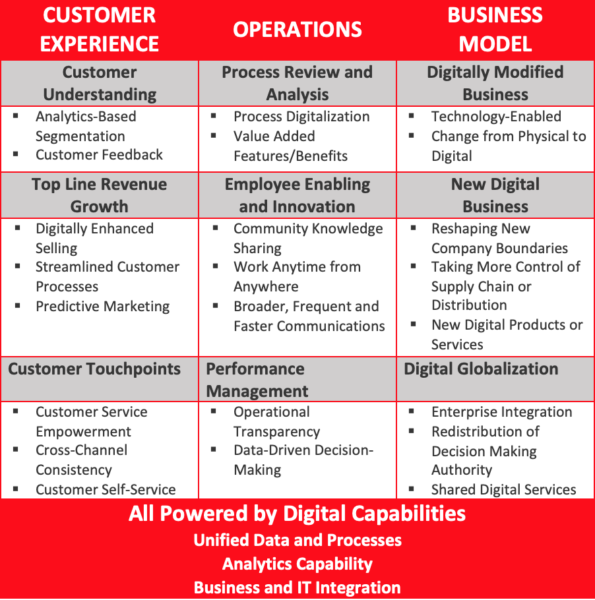
Major digital transformation initiatives are centered on re-envisioning the customer experience, operational processes and business models. The music industry never examined the phenomena of mixed tapes – custom cassettes recorded one song at a time and never realized that the album concept was out of date with consumers. Listening to your customer complaints, providing feedback loops that include senior management on decisions that will significantly delay the project or increase the budget is important, because ultimately they are responsible for the company’s fortunes.
Successful digital transformation comes not from creating a new organization, but from reshaping the organization to take advantage of the valuable existing strategic assets in new ways. They need to envision radically new ways of thinking.
6. Sunk Cost Fallacy
Companies are loathe to quit a project even if it’s going in the wrong direction. You may have hired the wrong consulting firm to manage this process. You may have already experienced delays and cost overruns. Many business leaders think, “We’ve already spent $18 million on this. We have to finish it.” No you don’t. You need to stop and seek alternatives. Throwing money at a broken wheel doesn’t fix the wheel.
7. Not Examining All the Building Blocks of Transformation
Most executives are digitally transforming three key areas of their enterprises: customer experience, operational processes and business models. Within each of the three pillars, different elements are changing. These nine elements form a set of building blocks for digital transformation. The tenth element– digital capabilities – is an essential enabler for transformation in all these areas.
Do you want to outsource this type of work so that you can focus on higher level activities?Subscribe today to learn more about building your business and receive a free PDF “Process Plan for Creating Your Own Innovation Program”. Feel free to email us to learn more about how we can help you grow your business.
When I moved to India 11 years ago, I had been (somewhat) active on the startup/entrepreneur circuit, engaging with people who wanted to become entrepreneurs. The reason I say “somewhat” is because it seriously disturbs me that people think it’s a big cake walk. That someone gives you money, you start a company, and then magically, you’re a rich man. That couldn’t be farther from the truth. Now that I am in Myanmar, I’ve worked with entrepreneurs in three countries. I love risk takers. I love risk takers that bootstrap their companies, because the gamble is far more personal. This post describes one of these high-risk ventures that happened while I was still in India.
For seven months, I had been working deep in the trenches getting a new e-commerce business going. For those of you who want to be an entrepreneur, here’s my take on what is involved.
As a new initiative for the company, it was essentially a startup within an established firm. We had a very small development budget and an even more limited marketing budget.
What started as a nice idea for serving U.S. small business owners who needed help recruiting candidates, during the planning phase it morphed into something unique in the industry. Many staffing firms use outsourcing firms to provide cheap candidate sourcing and screening and we worked with many of the best of them. These staffing firms were too expensive for U.S. small businesses, so we decided that we could offer a similar service at a price point that was affordable to small companies. To make this successful, we were intent on providing a simple and easy user experience, and the site had to be intuitive – make it clear where to submit an order, feature an easy payment process and a dead simple, affordable and fast delivery process.
We started with a different name. When we went to research our service mark and domain name, many of the options we were looking for were already taken, but our favorite was still available. Within the next 30 days, we tried to register it, only to find out some company in Arizona registered it a few days after Christmas. Blurg.
LESSON #1: If you have a great domain name, register it right away. Before anyone else gets the same idea. This is good for SEO. The longer you’ve owned the URL, the higher its rankings.
We decided to hire a local development firm who insisted that they managed their development iteratively, but that did not happen. They did not have the right people in their organization like designers and UI/UX specialists. The project cost us twice as much and took twice as long as expected, even though the bulk of the interface had already been designed by me. Most of the content on the site was created using WordPress and a gorgeous and affordable theme that I installed and created myself. I only needed them to do the backend magic. They did not develop use cases, document their work, nor provide any ability to do design reviews because everything was programmed by them before the process flow had been agreed upon. A number of times. But at least we launched. And the site was pretty decently bug-free for a BETA site. Seriously. I’ve dealt with plenty of Indian developers who do ABSOLUTELY NO testing before launching.
LESSON #2: Sit on the developers. Meet with them regularly. If they’re not meeting milestones, meet them more often, even if that means daily. I didn’t do this faithfully due to other pending projects.
We did not have staff in place to market effectively. We needed people who could manage social media, connecting with Americans and speaking authentically. It took a lot of training and exposure, but our staff were working at similar delivery levels to Americans doing the same work. I was very proud of that.
LESSON #3: Train, train and train again. Monitor and provide feedback regularly. Ask them to evaluate each other’s work, mentor each other and share information. Make them feel safe in testing new ideas, even if they fail. Learning it does NOT work is just as important as learning what DOES.
Forecasting staffing levels is always a challenge when launching a site. Some sites take forever to gain traction, others never do, others ramp up so quickly that service suffers. Our pricing structure depended on volume. Our staff had been exposed to “P&L Lite”, also known as “justifying our salaries”, which gave them insight into how startups work and what you need to be mindful of when making business decisions. I demonstrated how much traffic was required in order to convert a small percentage of visitors into sales. We had tough targets to reach. Our traffic had to get to 800,000 unique visitors a month to predict enough orders to cover costs.
LESSON #4: Be as transparent as possible with your staff. If they know what metrics you are following as a business owner, this will be translated into their priorities (hopefully). Explain why each metric is important and what is required to meet your business goals.
At the beginning, our staffing was all over the place. We had a set of dedicated staff, plus additional employees on the bench waiting for job orders. While in BETA, this was okay, but we still needed to start generating revenue. The way to get revenue was to drive qualified traffic to our site.
I provided them with tools, training, and templates and sent them off into the “interwebs” to drive traffic back to our site. We found shortened Google URLs or bit.ly’s to be great at tracking each individual’s contribution and sharing these insights with the staff to increase their own effectiveness and make a contest out of it. (Google’s URLs, however, were automatically tracked in Google Analytics, so we preferred them at the time.)
LESSON #5: If you have staff on the bench, train them to do marketing and sales activities. Everyone should be able to express who you are as a company. If they can’t, you have failed them and your business. Many mindless tasks can be assigned to people, like directory submissions, article submissions, link building, etc. Other disciplines, like social media, take more training. Expect it to take six months to see any success.
Life is challenging when launching a startup. My life was all about the new business venture for those months, from the moment I woke up and checked my emails, to the moment just before I went to sleep after checking my emails and traffic reports. I’d wake up in the middle of the night to send emails to myself about ideas on tweaking the web site, blog post ideas, etc. I skipped meals to accommodate yet another training meeting, or to visit my developers. I could not find a decent illustrator, so I created the images on the site myself. The entire user interface was designed by me, because I simply could not identify anyone, nor could our developer, nor anyone in our online networks, that was good enough to do the work. I wrote the bulk of the content myself, with feedback from the CEO.
I checked the quality of the backend code along with my fearless Operations Manager, who was leading the operations for this initiative. She spent weeks testing countless job orders, and broke the system many times, identifying lots of work for our developers. The Marketing Manager and the Social Media team were working night and day, establishing the right connections on social media. Every single person involved with this project dedicated themselves more than full time employees. I feel confident in saying that they were partnering with me to build this business. I was not merely trading a paycheck for their completion of certain tasks. They were with me. They knew the mission. They understood the excitement of launching a business and I shared with them throughout the process how I went about doing this. It wasn’t the first time I’d launched a business, in Myanmar, in India or in the U.S., so I hoped my background could help them learn the best practices I’ve learned, lo, these many years.
LESSON #6: Do as much as you can in-house. Use external contractors only when you don’t have internal people willing to try. If they try, and complete the task well, it’s cost you far less than a contractor would charge and your employee also gains confidence and learns new skills.
We had very little traffic in spite of our marketing efforts and I am convinced that it had everything to do with the backend tech. We were at one time blacklisted by our web host because the software was autogenerating PDFs and we had hundreds of thousands of documents on our web site. They were sure we were spammers. The load times were very high due to the number of plugins and scripts they had loading on the home page. Many times, the payment process would time out and the user would not only lose their payment information, but their job description and the entire order would be lost as well, requiring them to start all over. We had a bounce rate of 36%, which wasn’t bad, many reading the blog posts and starting orders, but the “built-from-scratch” cart coded by the tech company was killing us. Our abandoned cart rate was over 88%.
Our backend tech required entering resumes line by line by line into database forms because we couldn’t parse documents and have it identify correctly what field the data should go to. (Like I said, we had a crappy tech company working on this project). Whenever we had five or more orders in one day, it was all hands on deck, including me, entering resume data to ensure we got 15 resumes to the consumer for each order. Essentially, we lost money on every order. We investigated looking at Google ads and if we had actually had a click-through and a sale, our profit disappeared. We could have rebuilt the technology and we explored that opportunity. It would have cost an additional $150,000 to completely rebuild the service to the original specifications. We could have increased the price, but the staffing firms using our service were already asking for bulk discounts and complaining about the existing price, saying it was already too high. We did not see a clear way to move forward, and after a year, we decided to close to service. The “Sunk Cost” fallacy would have convinced us to reinvest and rebuild, but the prototype did not prove the concept was worth it.
LESSON #7: “Fish or Cut Bait” or learning when to pull the plug.
So would I do it again? Yes. In a heart beat. We all learned a lot. I would hire the right development firm. Use a tested e-commerce back end. I would not create a custom database backend with 50+ fields per resume. I would automate the resume entry process and the Resume Book PDF generation process. My staff worked really hard to make this a success and they knew the orders were just not coming. They knew it was just a matter of time before we closed it down. They were concerned they would lose their jobs. However, that turned out to be a turning point for the organization. We kept those staff who were doing well at marketing and created a marketing plan to promote our existing services. The operations staff went back into operations at the same level they’d been before. No one lost their jobs, although some left on their own.
Was it a failure? Absolutely. Did we learn a lot? Absolutely. But not taking the risk would have been far, far worse.
Do you want to outsource this type of work so that you can focus on higher level activities?Subscribe today to learn more about building your business and receive a free PDF “Process Plan for Creating Your Own Innovation Program”. Feel free to email us to learn more about how we can help you grow your business.
At Lycos, back when we were #2 after Yahoo!, we did a lot of user testing and it was a humbling experience. What seemed obvious to the UI/UX group and the web designers was clearly not intuitive to the users. There were days when I ranted to the team that there has to be a better way. We would spend a week performing user testing for a new service and then literally have to start all over. The process was simple. Generate a set of paid volunteers to come into a classroom and ask them to perform a series of tasks, all the while talking their thoughts out loud so we could record what they were thinking. This is an example of qualitative research.
I was also responsible for driving traffic which started off at 12 million page views a day. In 1999, there was no Google Analytics, Web Trends, or any sort of analytics software – just log files. Lots and lots of log files. I would take a days worth of traffic and export it into Excel. I would have numerous tabs to assist in selecting and deleting data in order for me to establish trends. The first data sort was pretty much a full day option of not touching the machine until the sort completed. I was searching for the most trafficked pages. I would then take the top one hundred thousand and put them in a second tab. I would then sort based on traffic and category (we had an excellent taxonomy team). I would then take each traffic and category and put them on separate tabs. This was painfully time consuming and remember, I am only looking at one day’s worth of data. At this point I could establish trends and realized the top visited sites that day were typically music fan pages – Britney Spears, Backstreet Boys, ‘Nsync, DMX, J-Pop, K-Pop, etc. Then while performing this exercise, our CTO, Tech Director and I were speaking about this when the CTO said that it looked like more than 90% of our traffic were coming from maybe 5% of our users, all focused on these topics. This type of research is an example of quantitative research.
It’s important to understand the difference between qualitative and quantitative research. Qualitative and quantitative research serve incredibly different purposes. Each method for marketing research involves a different process, and reveals different information. However, it is wise to conduct both quantitative and qualitative market research whenever possible. In the two scenarios above, one focused on user experience of a web-ring technology we were testing to see if it made the site more “sticky” (kept them on the site longer), while the other was used to identify existing traffic patterns and how to increase traffic within the site by beta testing our new web-ring technology only on those high trafficked sites, since the traffic patterns of the top 5% of pages would be massive and if the new tech did increase traffic, it could significantly increase our pages overall by shifting traffic to other pages with the same or similar content.
Quantitative Market Research
Quantitative research generates data that can be transformed into useable statistics. It is used to measure trends in attitudes, behaviors, and other defined variables, from a large sample population. Quantitative research measures data to uncover patterns in research.
Quantitative data collection methods are much more structured; they can include various forms of surveys, telephone interviews, longitudinal studies, website interceptors, online polls, and systematic observations. They can also be used on the back end by analyzing incoming traffic where users go, when they leave, how long they’re on site, and more. In my opinion, this data is far more reliable as humans do not always remember the facts as well as user logs or data analytics – even your browser history. Think about it. How many web sites did you visit yesterday? Go to your browser history and count them. I guarantee you were way off and the actual number was much higher than you expected.
Quantitative market research is the collection of data to analyze trends in the data. As a result of the standardized questions when doing any form of surveys, quantitative market research can involve a larger number of respondents to participate in the research. One caveat to surveys is that there can be significant bias set up in the creation of the survey questions. There are numerous studies that document this confirmation bias effect in market researchers, especially when the study plays a huge stake in whether the project moves forward or is closed down.
Qualitative Market Research
Qualitative research is often used to explore improvements to existing products or services or to introduce new products and services. It helps researchers gain an understanding of what works, what doesn’t, why they would purchase or not, whether they would recommend it to a colleague or friend… It provides insights into any issues or pain points that the product or service still does not solve.
Qualitative research methodologies vary from focus groups, individual interviews, activity observations or immersions, and diary studies. The sample size is typically small, and respondents are highly targeted to match market personas that the company assumes will be primary and secondary consumers of their product or service.
Qualitative market research helps marketers understand why a consumer has acted and purchased in a certain way. It does not follow a predetermined set of questions but provides topic or discussion guides to ensure that the research remains consistent and the same questions are asked to each participant. During the research, the researcher is able to explore responses in more detail allowing for longer discussions that could reveal a vast amount of information the research never expected or accounted for. By understanding consumer viewpoints, emotional responses, and purchasing behavior, it can allow companies to alter and adapt their ideas to ensure consumer satisfaction and competitiveness within the market or alter a product or service to align with customer needs, allowing them to be competitive.
Selecting a Testing Methodology
Both quantitative and qualitative market research can be conducted first. The method to choose first is dependent on the following;
Qualitative market research should be conducted before quantitative market research if the project concept has not previously been researched. In this situation qualitative market research will enable the researcher to understand the consumer’s initial and unbiased reaction and opinions to the new concept with no external influencers such as past experience with similar products. It is important with a new concept to first understand areas of improvement, modification before moving forward towards validating the final concept through quantitative market research.
Quantitative market research should be conducted before qualitative market research if the project concept has been previously researched to some extent and some initial information from previous research has been absorbed. By conducting quantitative market research first, it allows an entrepreneur to understand the current feasibility of a project before understanding why the results read as they do. Quantitative market research highlights areas of further investigation before exploring the reasons through qualitative market research. Further to this quantitative market research allows the researcher to gauge a general understanding of the market before taking the time to adapt their research into a more specific and customized survey as part of qualitative market research.
Learning from the Data
In user research, quantitative data tells you what users did, and qualitative data helps you learn why they did it.
Let’s go back to my experience at Lycos, where we used qualitative user interface testing through human users completing tasks. If you were to measure their behavior on the website in order to keep them on the site longer, you might learn that 25% of people clicked on this button, then another button, and so on. This data is good, and you can run split tests (otherwise known as ‘A/B’ or ‘multivariate’ testing) to try out different versions of your prototype to see if you can change people’s behaviors. But we also asked people to think out loud in order to capture their thoughts, feelings and asked them why they did what they did.
So, using the same example — we used quantitative methods by sorting traffic logs to understand how many people were visiting what pages, for how long, in what category, and what they did next.
In your research, consider using both qualitative and quantitative methods together to be better equipped to solve the problem at hand. In this example, adding traffic meant that we had to run both, first to set a benchmark and second to measure changes in traffic. We selected the top performing topics and created a subset of these pages, calling them BetaPods (I don’t know why). We could not put advertising on users’ home pages as most companies weren’t comfortable with potentially harmful content that would reflect poorly on the brand. Out CTO and Tech director had found a snippet of code in Netscape and Microsoft Explorer that enabled us to exploit the ability to open a new browser window. Yep. That’s right. We invented the scourge of the internet in order to place advertising in a different window than the user’s home page.
Our first browser popup had one 468 x 60 pixel banner ad, and two smaller text ads to the right. We used a text link as well under the banner ad, since previous testing had shown that the link got 78% of the traffic over the banner ad itself. This original popup menu generated less than .003% click-through (aggregate – there were 17 individual links in the popup), or an additional 36,000 page views on 12 million page views a day.
Original Popup Menu: Generated less than .003% click-through (aggregate).
Our first test changed the popup to include a Lycos search bar, but that sent traffic to Lycos, which although it was part of the network, we really wanted more traffic to our own pages. We also added automated category pages that listed all the members’ pages that matched the taxonomy of the current page. The new popup generated more than a .01% click through rate on an aggregate of seven links, which added an additional 120,000 page views per day.
New Popup version 1.0: Generated more than a .01% click-through (aggregate). Doubled traffic to commerce partners and generated more than 10,000 referrals per day to the network.
Our final popup used both the quantitative data and the qualitative data. If a person was reading a Britney Spears page, it was likely that they would be interested in more Britney Spears pages, or may also be interested in other pop music bands such as ‘Nsync and Backstreet Boys. Using web-ring technology and changing the taxonomy and algorithm, the new popup now generated more than a .05% clickthrough rate, generating 600,000 additional page views per day.
New Popup version 2.0: Generated more than a .05% click-through (aggregate).
The new popup menu design enabled the team to reach our target of 16 million page views in nine months rather than in one year as expected. So give both methodologies a try – you never know what will work. Human beings are unpredictable, fickle and very different from each other. Testing will humble you. Testing will frustrate and infuriate you. But you learn something new every time that will make what you make better.
Do you want to outsource this type of work so that you can focus on higher level activities?Subscribe today to learn more about building your business and receive a free PDF “Process Plan for Creating Your Own Innovation Program”. Feel free to email us to learn more about how we can help you grow your business.
Plan and implement an online marketing strategy to generate targeted traffic to the web sites. There are many aspects to online advertising from simple banner ads, Google Adwords, to rich media placements. Identifying the correct sites to advertise on is key.
Evaluate not only the unique visitor numbers (to maximize exposure to your market), but location, if you are focused on a particular market. Review “real estate” – when negotiating with a site, check what ads sizes and locations are available and whether sub-pages would be preferable. Ad management and rates are all over the place. Test lots of ad sites AND A/B test ads to see what drives traffic. Is it an offer for a free white paper? Is it a free 90 day trial of your online service? Testing different approaches is crucial to find out what are the emotional touchpoints that will drive click-throughs to your web site.
Online Advertising Campaigns consists of the following fundamentals:
Online Advertising Campaign Management
Advertising Creative Concept Development
Ad Network Media Buying / Placement Services
Adwords/Adsense
Pay per Click (PPC)
Cost per Action (CPA)
Banner Advertising
Web Site Sponsorships
Native Advertising
Advertorials
Sponsored Content
Do you want to outsource this type of work so that you can focus on higher level activities? Subscribe today to learn more about building your business and receive a free PDF “Process Plan for Creating Your Own Innovation Program”. Feel free to email us to learn more about how we can help you grow your business.
Many founders assume that tech incubators and tech accelerators are the same thing. They are clearly not, but I can certainly understand how founders could see them that way. There are a few distinct differences between accelerators and incubators and it has everything to do with when in the startup’s growth cycle they are looking for funding. Founders should be aware of this before they start their funding road trip because it could save him/her a lot of time and expense. Both tech incubators and tech accelerators offer great opportunities to assist startups and founding teams to head in the right direction, but it’s up to you to identify where you need to start.
What Makes Tech Incubators and Tech Accelerators the Same
Both can offer founders help with structuring their company
Both can assist in talent acquisition
Both can help founders find and negotiate with vendors/partners/distributors
Both can provide small seed capital in exchange for a small amount of equity
Both can better your chances of attracting top Venture Capital (VC) firms for later investments
Both have mentor networks typically composed of startup executives, industry experts in their vertical, VCs, and other potential investors.
What is Different About a Tech Incubator
Tech incubators are all about innovation.
Tech incubators take disruptive ideas and work closely with the founding team or company (sometimes even a single entrepreneur) to create their Minimally Viable Product (MVP) or service.
Tech incubators assist founders in creating a sustainable business model, revenue options, and help commercialize their idea.
Tech incubators come in all different sizes and are funded by several different types of organizations, from government agencies, VCs, angel investors or major corporations. The amount of money can be very limited.
Some tech incubators focus only on certain industry verticals such as fintech/finserv/cryptocurrency, education, health technology, or robotics.
Once accepted into the program, you may have to move your team in order to be close to other companies focused on the same industry vertical. Within this startup ecosystem, you can network with other entrepreneurs, build out your business plan and revenue model, identify any intellectual property issues, as well as work on market-product/service fit.
What is Different about a Tech Accelerator
Tech accelerators are all about scale.
Tech accelerators usually select early stage companies already in business.
Tech accelerators attempt to hack the growth of an existing company that already has their MVP, perhaps a few clients, and need guidance on increasing marketshare, monetizing their product or service, advising the team on how to prepare for their next round of funding, etc.
Tech accelerators have a set time frame for an individual company to work with a group of mentors to build out their company and avoid problems mentors have already solved.
Accelerators typically end their program with a pitch day, where external VCs, investors and media are invited and the Q&A can be brutal. Understand your business, the marketplace, your revenue model, and the rest of the numbers and be ready to defend them. After this you are on your own. You and your founding team should be developed, vetted and ready to lead.
When Planning Your Fundraising Program
Decide whether a tech incubator or tech accelerator is right for you based on what stage your company is in.
Find the tech incubator or accelerator that specializes in your industry vertical, if there is one (or two or three). Make these part of your fundraising program.
Search through their mentors and see which incubator/accelerator has mentors in your industry. Make these firms a priority.
Most tech incubators have an application process. Read through each application to understand what eligibility requirements you need to meet and the information required to apply. Follow the deadlines and ensure your application is written flawlessly and thoughtfully.
If you have an MVP and a few clients you may want to skip the incubator and go straight to an accelerator. Tech incubators focus on getting a couple of year’s experience into the founding team through an intensive development and mentoring program. Some tech incubators have an application process, but most rely on their network of mentors and partners in order to get nominated to apply to the incubator. You’ll probably need to pitch your idea, so be prepared. For more information on pitching, read here.
Most tech accelerators rely on their networks while some still like to conduct pitch days to identify new companies to add to their organization. Put these events in your calendar and don’t miss the opportunity to pitch. Practice will help you perfect your presentation.
The Co-Working Option
While some tech incubators feature a shared space in a co-working environment, a month-to-month lease program, additional mentoring, and some connection to the local community, independent co-working options are readily available in most major cities. Co-working is a separate business offering, with co-working spaces charging rent for access to utilities, conference rooms, reception services, etc.
For those companies that haven’t been able to get funding through a tech incubator or tech accelerator, this option gives you access to other companies in varying stages of growth and networking with other firms and founding teams sharing the same space. This access can be worth much more than the money provided by the incubator or accelerator. Getting your company to the accelerator-ready stage can help you avoid giving away equity you may not need to provide in exchange for cash.
Bootstrapping – the Final, Most Frightening Frontier
Many companies simply start with a little bit of money borrowed from friends and family and go it alone. This is by far, the riskiest but most advantageous option of all as it enables you to create your vision your way. If you have already worked in a series of startups, or are a serial entrepreneur with a number of companies already exited, you may not need to go for any funding. For more information on the pros and cons for bootstrapping, read here.
Whichever way you go, if you have an idea that you want to move forward with, there are multiple ways to see that dream come true. It just takes work. A lot of it. But it’s all worth it.
Do you want to outsource this type of work so that you can focus on higher level activities? Subscribe today to learn more about building your business and receive a free PDF “Process Plan for Creating Your Own Innovation Program”. Feel free to email us to learn more about how we can help you grow your business.
Most startups don’t need a board of directors. If you’re a public company, in most countries, by law, you need to have one. Whether or not they are effective is a different point. The purpose of a board is to provide governance, supervise the activities of the company, and represent the shareholders. Boards can be called boards of governors, advisors, regents trustees, etc. and most do the same things. In some cases, they may also do fundraising.
There are different types of board members: internal, those who are typically employees, major shareholders or union representatives; the other type are external, those who are not active in the day-to-day operations of the company and don’t deal with that level of detail. The tend to bring an outsider’s perspective to issues and disputes and can more effectively address concerns due to their external experience.
So when is the right time to build out a board of directors for a startup? It all really depends on what you need. Do you need advisors in certain industries to assist in establishing contacts and advice for growth strategies? Are you looking for investment? Many investors like a seat (or two) on the board to control the ongoings of their investments, so you may be forced to develop a board from the onset. You may be gearing up to go IPO and need your bylaws and board in place in order to start that process.
Four Tips for Building a Strong Board of Directors
The best way to start is to just get out a piece of paper and start naming names. Do some research on each one. What boards are they already on? Who are they already invested in? Do they have any conflicts you need to be aware of before approaching them? Do they have any of the following experience (because you’ll want this mix on your board):
Previous and Current Board Experience
Evaluation Capabilities – experience dealing with valuation and term sheets
Financial Governance – ability to understand your P&L
Fundraising – connections to investment
Human Resources – connections to people
Legal – understanding regulatory and legal compliance issues
Marketing – understanding your market
Planning & Strategy
Programs and Services
As you start your list, keep the following tips in mind.
#1: Seek Diversity.
When developing your list, also evaluate the range of skillsets, types of experience and perspectives that will provide you with the best strategies for the growth and success of your company. A good example of a bad board selection would be Theranos, which had no board directors with biotechnology or medical expertise – a serious red flag in a market with huge regulatory processes. The makeup of the board facilitated one of the greatest frauds in Silicon Valley. Look for directors with experience and perspective that will give you insight into your stakeholders (customer segments, funders, regulators, etc.) as well as your product/service development.
#2: Boards Are Not Management.
A board oversees governance and strategy, gives feedback and assists management, rather giving instructions, mandates and standard operating procedures to management. A caveat on this one: sometimes founders can get in over their head in areas where they have no expertise and your board may have more experience in that area. For example, managing your finances should have a clear and easy to follow standard operating procedure with, for example, rules as to what is and what is not reimbursable as “entertainment” when sales people are out with clients.
#3: Set Clear Expectations.
When approaching potential board members, be clear about what you expect from each member (and it may vary widely): insight, support, introductions, regulatory assistance, funding, credibility, etc. An experienced board member will look to add value, and it will be easier for a prospective board member to see if they can meaningfully help you grow your company. The also need to understand the time commitment involved and your long term vision and exit strategy (if you have one).
#4: Recruit From Many Sources.
Don’t look at just the “usual suspects”: current board members of similar companies. In fact, my preference is to focus on symbiotic companies as I consider a board member already in my industry to be in conflict since he is already on the board of a potential competitor. Look for brand similarities or industry sector similarities. Look for a mix of experienced board members, but don’t let lack of board experience deter you either. Fresh board members bring energy and new insights to the table.
Identifying and Approaching Potential Board Members
Use your network. They know and can suggest the right people and can make introductions for you. You might also look at your existing partners or suppliers since they already work with you and have a vested interest in your success.
Plan your approach similarly to how you would pitch to a potential investor. Personalize it to describe the key segments from the list above that you think they could help you accomplish. Some large companies pay them a stipend or stock options. Other companies hire a search firm (costly and not always the best way to identify the right people).
Even is your startup is only a few people, what you are building may be of significant consequence to very important people, so go big or go home. Major investors, CEOs, famous celebrities – you never know who would be interested and they all bring their reputations, connections, and experience to the table. Don’t be shy. The worst thing they can say is “no”.
Once you’ve found the right people and they’ve accepted to be part of your venture, it’s a good time to get all the paperwork in order, have your first board meeting and send out a press release. The right board of directors can really guide a founder to accomplish their vision and change the world.
Do you want to outsource this type of work so that you can focus on higher level activities? Subscribe today to learn more about building your business and receive a free PDF “Process Plan for Creating Your Own Innovation Program”. Feel free to email us to learn more about how we can help you grow your business.
I have a confession to make. I’ve never learned to code. Sure I can write HTML and be dangerous with CSS and ASP (which I seriously haven’t used since 2006), so I am pretty dependent on WordPress and Shopify to make web sites and, personally, for brochure and simple e-commerce web sites, you really don’t need anything else. But what about those other web sites and apps that need more in-depth experience or just even tweaks to existing template designs you’ve picked out for your site? If you don’t know how to code, how do you select the right company?
First start by writing your own requirements documentation and use cases. (If you need these, email me. I’m seriously awesome at these.) What is the web site supposed to do? Who will the users be and what will they do when they visit? Once you have that documentation ready, you can then start reviewing development companies for your project.
Ask the Right Questions:
Who are the founders and their background? Are they both previous developers or did they have other positions? Did they work at recognized companies in leadership positions? How are they represented on glassdoor.com? Do their staff complain about them? Double-check their backgrounds. Did they really go to Stanford? Did they really work at Google?
Who’s on their leadership team? Who would be in charge of your project? Do they have experience in your industry? Have they done work similar to yours in the past?
Do they have a full complement of skill sets on their team? Most development companies have a huge team of developers, but no UI/UX specialists, data architects, web designers, quality assurance staff, etc., to fully complete the project. I found this out the hard way when I asked one company we hired to give me the designer who came up with certain designs in their portfolio, only to find out that those were all done by their clients.
Have you called their references? While typically always positive, come up with open ended questions that could open them up to get to some issues, such as “What one thing do you think they could have done better at?” or “What would keep you from recommending them to someone in (your industry)?”
Have you identified other companies they didn’t offer up as references and contact them? Look around and see if you can find anyone who’s used them in your industry or have web sites that have special requirements that are similar to yours. This may not be as hard as it looks since many web firms still like to put their names in the headers of the code, but it may not be that easy. You might try seeing if they come up as the technical resource on whois.org or similar domain registration sites.
What is the experience of the team they intend to assign to your project? If you have special criteria, for example, parsing data or creation of PDFs, does the team have experience in these critical skills? I was burned by getting a new developer whose first job was mine which required parsing resume data from multiple formats and job portals and turning them into lovely pre-formatted PDFs. Had I known her background, she would not have been the one working for me.
It is strongly recommended that you review the contract and ensure language is in place that puts a deadline on the project with penalties for delays. Also, keep to a per project pricing, rather than hourly or retainer pricing. Development companies prefer this type of payment process due to what is called client “scope creep”, where the project keeps changing, adding features and other components not originally in the requirements documentation. It is YOUR responsibility to manage scope creep, not them. You SHOULD be charged for it.
Start out with a smaller project. See how they interact when you don’t like how the site looks or how they’ve changed something from the requirements documentation you gave them. See how they react when YOU make a change to the requirements. A great little project is developing a customer survey form or subscription form, maybe even a payment platform for an existing site (you’ll need to have merchant IDs and all your payment options in place in order to offer up that one as a test, however). Unless you plan on doing e-commerce and can use it as part of your later larger project, stick to something else.
Lastly, if you know anyone technical, even a friend or a college intern, who can just take a look, they can can at least give you their impressions, but it pretty much still is a tough call choosing the right company. Good luck!
Do you want to outsource this type of work so that you can focus on higher level activities? Subscribe today to learn more about building your business and receive a free PDF “Process Plan for Creating Your Own Innovation Program”. Feel free to email us to learn more about how we can help you grow your business.